
The real Padma bridge corruption conspiracy
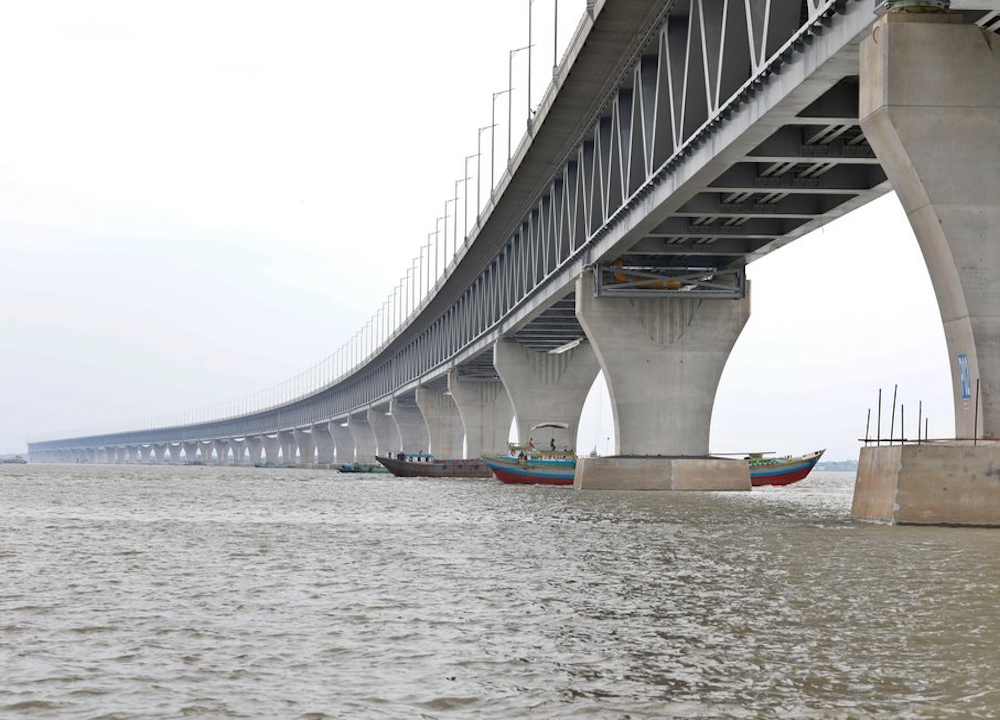
Bangladesh government’s extraordinary campaign to deny the Padma bridge corruption conspiracy ignores an admission by SNC Lavalin that it sought to bribe government officials.
Authoritarian governments love to rewrite awkward histories, and with their control over the media, the courts and every other state institution, they generally are able to do so.
Bangladesh’s governing Awami League and its acolytes are right now in the middle of doing their very best to erase from people’s minds the corruption scandal that resulted in the World Bank in June 2012 cancelling its $1.2 billion loan to the Bangladesh government to build the Padma bridge.
The scandal, which was uncovered by the World Bank, involved the Canadian company SNC Lavalin which was seeking to bribe Bangladesh government officials so that it received a $50 million contract to supervise construction on the bridge. In its press release about the cancellation, the World Bank stated: “The World Bank has credible evidence corroborated by a variety of sources which points to a high-level corruption conspiracy among Bangladeshi government officials, SNC Lavalin executives, and private individuals in connection with the Padma multipurpose bridge project.”
Bangladesh government wants to replace this with a contrived narrative about how there was in fact no corruption, and that people instead have conspired against the government to falsely accuse its officials of involvement in corruption and to blacken the country’s name.
There are a number of notable aspects about the government’s attempt to replace established facts for its fake narrative.
Company’s admission of culpability
In all the remarks made by Prime Minister Sheikh Hasina, echoed by her followers and set out in the articles written by pro-government columnists, there is a crucial and determinative fact that they never mention. That in April 2013, the Canadian company SNC Lavalin admitted to the World Bank that it was involved in a “conspiracy to pay bribes” to Bangladesh government officials in its attempt to win a Padma bridge contract.
We know this because the Canadian company did not contest the allegations against it but agreed to a “Negotiated Resolution Agreement” with the World Bank which resulted in the debarment of SNC-Lavalin Inc and over 100 of its affiliates for a period of 10 years. To get the benefits of a negotiated settlement SNC Lavalin had to admit its “culpability” in seeking to pay bribes to government officials and agree to cooperate with the World Bank’s investigation.
A World Bank spokesperson confirmed this to Netra News, “All INT settlements require the settling company to acknowledge engaging in a sanctionable practice under World Bank rules; and to commit to cooperating with INT,” INT refers to the World Banks’s “Integrity Vice Presidency”, which undertakes investigations into alleged corruption.
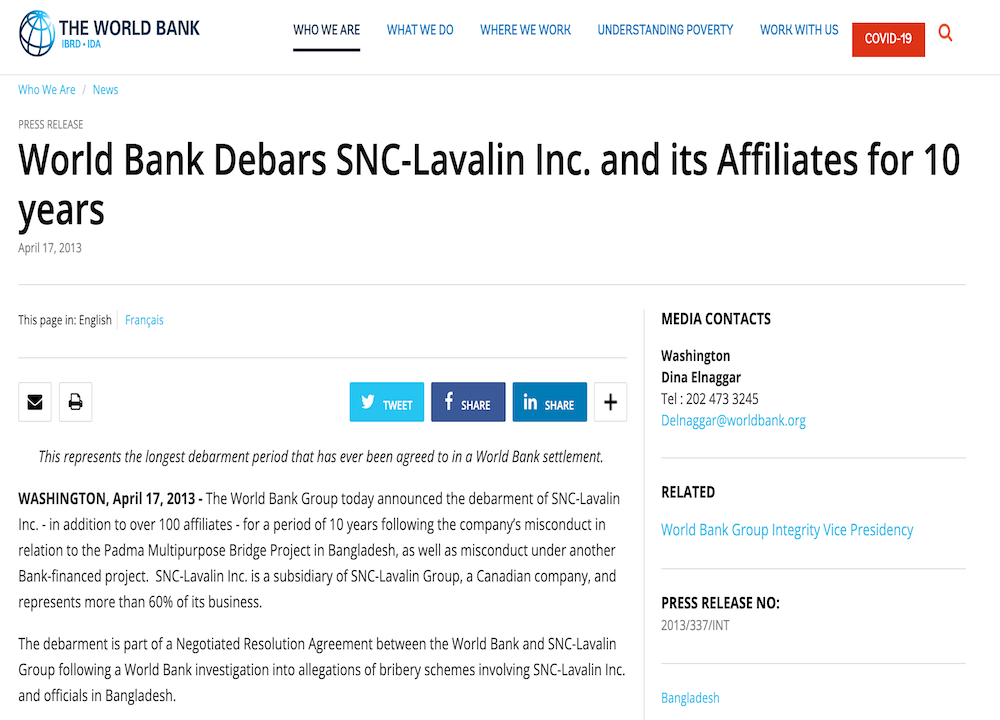
The press release on the World Bank website, dated April 17th 2013, states the following:
“The World Bank Group today announced the debarment of SNC-Lavalin Inc. — in addition to over 100 affiliates — for a period of 10 years following the company’s misconduct in relation to the Padma Multipurpose Bridge Project in Bangladesh…
The debarment is part of a Negotiated Resolution Agreement between the World Bank and SNC-Lavalin Group following a World Bank investigation into allegations of bribery schemes involving SNC-Lavalin Inc. and officials in Bangladesh…
SNC-Lavalin’s misconduct involved a conspiracy to pay bribes and misrepresentations when bidding for bank-financed contracts in violation of the World Bank’s procurement guidelines. Under the agreement, the SNC-Lavalin Group and its affiliates commit to cooperating with the World Bank’s Integrity Vice Presidency and continuing to improve their internal compliance program.
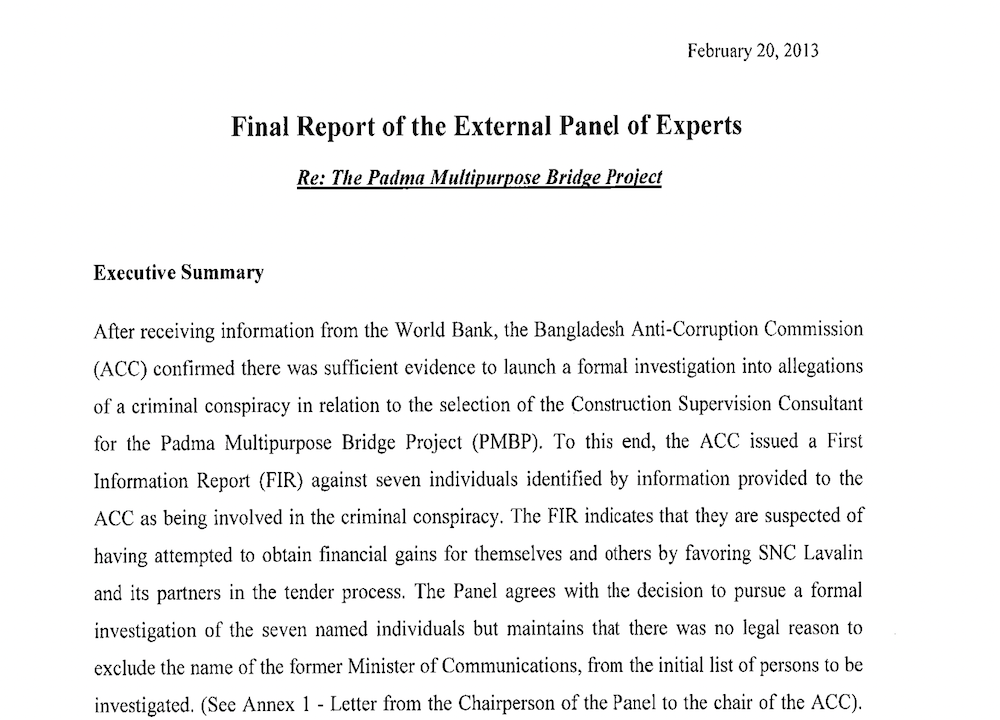
the February 2013 report of the External Panel of Experts
So, one has to ask this. How, prime minister, could there be a conspiracy against Bangladesh involving conspirators trying to blacken Bangladesh’s name with supposedly false allegations of corruption, when the company, at the centre of the allegations, formally admitted to seeking to bribe Bangladesh government officials?
Are the Sheikh Hasina, the columnists and all those echoing their arguments somehow expecting us to believe that SNC Lavalin admitted to a conspiracy to bribe Bangladesh government officials — accepting ten years debarment of the company and its subsidiaries — when the allegations of corruption against it were actually not true?
SNC Lavalin is no longer on World Bank’s debarment list as it was able to reduce the ten year sanction to eight years by complying “with all conditions of the agreement.” The settlement agreement is, however, not a public document.
Bangladesh’s Anti-Corruption Commission
Another key point entirely left out of the “conspiracy against the state” narrative made by government and its supporters is the fact that there was a time when Bangladesh’s Anti-corruption Commission’s own inquiries accepted that SNC Lavalin was involved in a conspiracy to bribe government officials. The letter of the World Bank’s Expert Panel of Expert which was sent to the ACC on January 9th 2013, and leaked to the media, noted the following:
c. During the procurement process Ismail Hossain, director of an SNC Lavalin subsidiary, represented the company. In the opinion of an SNC manager “the Secretary and the Minister” were dealing with him. On March 14, 2011, Ramesh Shah, Vice President of SNC Lavalin International was asking for the “PCC cost on the project in detail.” PCC is a euphemism used by SNC Lavalin to indicate the cost of the bribes to be paid.
The High Court decision
The High Court ruled on June 28th 2022 that the government must establish within 30 days a commission of inquiry to “identify the conspirators who have been spreading false news of corruption in Padma bridge project.” The High Court had earlier stated that those who have criticised the bridge construction were “enemies of the country” and “must be identified.” This decision to set up a commission to investigate a non-existent conspiracy against the state is yet further evidence of how the High Court has become totally suborned to the current Awami League Government and its political agenda.
Had the High Court undertaken any form of independent judicial enquiry and not simply relied on biased and partisan media reports that were the basis for this order, they would have found there was absolutely no need for a commission, since no “false news of corruption was spread”. Instead, as shown above by the evidence obtained by the World Bank and shared with the ACC, along with SNC Lavalin’s own admission of guilt, there was indeed a conspiracy to bribe Bangladesh government officials.
Let's hope that someone actually sends this commission, if and when it is set up, a copy of the World Bank press release, the letter of the Panel of Experts and the initial First Information Report written by the ACC, so it does not waste any time in digging up a non-existent conspiracy against the government and the country.
Corruption in Bangladesh
The government’s claims that a government contract did not involve corruption no doubt appeals to a nationalist sentiment, but it is so counter intuitive to most Bangladeshis, that one wonders whether it will really persuade anyone.
This is because the government’s narrative cuts across what practically everyone in Bangladesh knows about systemic corruption in the country; how it exists in just about every government contract; how influential government connected “middle-men” are used to extract money from companies with the promise that this will help them get the contract; and how this results in the financial enrichment of key decision makers including ultimately many senior government ministers.
Ordinary people know about how this all works, even if they are not involved in seeking government contracts, because so many of them are forced to pay hundreds of thousands of takas (equating to thousands of dollars) simply to get their son, cousin, sister or brother the chance of a government job — whether it be for a basic position as a teacher, a police officer, or a soldier. People are well aware how this ritualised corruption results in key decision makers, including many senior government ministers, lining their own pockets.
So, it is unlikely that most people will really believe that there was “no corruption” in this one contract involving the Padma bridge. The only thing unusual here is that the attempted corruption was discovered, investigated and had repercussions.
The smokescreen
Those seeking to claim that there was no corruption in the Padma bridge procurement process focus on one thing, and one thing alone — and that is the acquittal in Canada in February 2017 of two former SNC Lavalin executives and a Bangladeshi Canadian businessman who had been criminally charged individually with corruption.
The acquittal followed a decision by a Canadian judge that wire-tap surveillance evidence obtained by Canadian police — that was crucial to the prosecution of the men — could not be used in a trial against them as an earlier judicial order to permit the wire-taps had not been properly given. As a result of this decision, the Canadian prosecutors decided that they could not proceed to trial. The acquittals were, it should be noted, not evidence based, but based on procedural failures. Who knows quite what would have happened if the wire-tap evidence had been allowed to be used in the trial?
However, even without a trial convicting these men, what is important about this decision, is that it does not take anything away from SNC Lavalin’s prior admission of culpability for involvement in a conspiracy to bribe Bangladesh government officials.
Pro-government columnists publishing in the Bangladeshi media have attempted to mislead people about the Canadian judge’s comments made in his decision about the initial “tipsters”. The "tipsters" are the people whose claims the Canadian authorities has used to obtain the initial permission to tap the communications of the accused. The judge said these tips amounted to “nothing more than speculation, gossip and rumour.”
As noted elsewhere, the columnists and government advocates completely misrepresent the nature of these tipsters — seeking to give the impression that their tips were all the evidence that the World Bank had prior to its decision to allege corruption and end its loan to the Bangladesh government. This is not the case. These were just the initial tips received by the World Bank in 2011, which triggered its own investigation. In March 2011, the World Bank passed this information to the Canadian police who then used the information to secure a warrant that allowed them to wire-tap individuals allegedly involved in the corruption, in real time.
Subsequent to receiving the information from the tipsters, the World Bank undertook its own investigations, which included obtaining documents (and apparently emails) from SNC Lavalin. The company in June 2013 admitted culpability in a conspiracy to bribe Bangladesh government officials. It was on the basis of this evidence — some of which is set out above — that led to the World Bank suspending its loan to the Bangladesh government and the company admitting its involvement in the conspiracy to corrupt Bangladesh government officials. The tipsters' evidence by then was totally irrelevant, as the World Bank had by this time subsequently obtained actual evidence of the corruption conspiracy.
In fact, although the Canadian judge held that the information given by the tipsters was “nothing more than speculation, gossip and rumour” — and not sufficient to justify a warrant for surveillance — the evidence subsequently obtained by both (a) the investigation by the World Bank and (b) the evidence contained in the wire-taps (which could not be used in the trial) proved that the tipsters claims were completely correct.
Authoritarian governments are, we know, not dissuaded by facts. Indeed they try to make up new facts that support their own contentions. Let's hope that the Bangladeshi people are not as easily persuadable by false claims as the current Awami League governments hopes that they are.●